
Breathing well through your nose is essential for runners. Adequate nasal airflow warms, filters and humidifies the air, improves your sense of comfort and contributes to more efficient gas exchange, which can translate into better performance and less fatigue throughout your training sessions and races.

Allergic rhinitis and exercise
Allergic rhinitis is one of the leading causes of nasal obstruction in runners. Exposure to pollen, dust, mites and animal dander inflames the nasal lining, leading to congestion, sneezing and itching precisely when the body needs greater airflow. During a run, this internal swelling narrows the nasal passages and favors mouth breathing, which is less efficient and more uncomfortable, especially on cold or dry days.
Nasal obstruction and its impact on running performance
When the nose does not ventilate well, the need to breathe through the mouth increases, which tends to raise the perceived effort and the breathing rate. This may result in an earlier sense of tiredness, a drop in pace, poorer sleep quality from nighttime congestion and reduced recovery between sessions. In long races, breathing exclusively through the mouth also favors a dry mouth, sore throat and greater thermal discomfort, all factors that can undermine consistent performance.
Benefits of medical treatment
Well-managed medical treatment reduces inflammation and swelling of the nasal lining, restoring airflow through the nose. Saline solutions, intranasal corticosteroids and antihistamines, combined with a strategy of environmental control and adjusting training times according to allergic triggers, often greatly improve breathing comfort. In selected cases, allergen-specific immunotherapy may reduce nasal reactivity over time, bringing more stable symptoms and more predictable performance.

Nasal dilators while running
Nasal dilators can be useful allies for runners who notice their airflow worsening during more intense efforts. There are two main categories: external adhesive strips, which gently pull the nostrils outward, and internal devices, usually made of silicone, that keep the nasal valve open. In both cases, the goal is to reduce collapse of the lateral wall and ease the entry of air, especially during sprints, climbs and dry or cold days.
In practice, they offer an immediate effect, are affordable and may lessen the feeling of suffocation, the need to breathe through the mouth and the discomfort of a dry mouth. They work best when rhinitis is under control and there is a mild component of valve weakness, serving as a complementary strategy in training, races and periods of greater exposure to allergic triggers. It is important to try different models and sizes, observe how the skin tolerates the strips and how comfortable the internal devices feel, always maintaining nasal hygiene and the medical treatment recommended by your specialist.
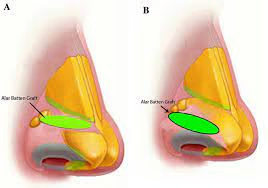
Like any external solution, its effect is temporary and the response is individual. They do not correct structural causes of obstruction, such as a deviated septum, turbinate hypertrophy or significant collapse of the nasal valve. If you find yourself constantly depending on a dilator in order to run, a detailed otolaryngologist (ENT) evaluation is recommended to define a lasting plan. In fact, a good response to dilators may indicate that surgical valve reinforcement will bring sustained benefit; in cases of collapse during vigorous inspiration, the alar batten graft stabilizes the nasal valve, offering durable improvement in breathing comfort without compromising appearance.

When surgery comes into play
Not all obstruction is purely inflammatory. A deviated septum, turbinate hypertrophy and structural weakness of the nasal valve can keep congestion going even with optimized medical treatment. Surgical correction, when indicated, aims to restore anatomy and function, allowing the nasal airway to support the increased airflow of exertion without collapsing. Procedures such as septoplasty, turbinate reduction and reinforcement of the nasal valve are individualized, focusing on a lasting functional result and a safe return to activity.
Alar batten for intense effort
In many runners, closure of the external nasal valve during vigorous inspiration is the critical point of the obstruction. The alar batten graft acts as a discreet reinforcement of the lateral wall of the nose, preventing collapse during peak airflow. In practice, this means freer air entry during accelerations and climbs, less of a suffocating feeling, reduced reliance on mouth breathing and greater comfort at high paces. Beyond the functional benefit, a well-planned reinforcement preserves the appearance of the nose, a key aspect for those seeking a complete and lasting solution.
Next step
If nasal obstruction is limiting your training and holding back your running performance, a thorough evaluation with nasal endoscopy and functional testing helps shape the ideal plan for you, from advanced medical management to structural correction when needed. The practice of Dr. José Eduardo Marcondes, an otolaryngologist (ENT) with more than two decades of experience, offers personalized care at premier locations in São Paulo and Alphaville. Book a consultation and get back to running while breathing through your nose, with comfort, safety and high performance.
Dr. José Eduardo Marcondes, physician, otolaryngologist (ENT). CRM-SP 107.711 (Brazilian medical license) | RQE 43.840 (specialist registration). This content is informational, does not replace a medical consultation, and does not supersede the plan of care defined by your own physician.
Sleep well again.
The diagnosis is individual. Book a consultation and find out what applies to your case.
Read also:
About the author
Dr. José Eduardo Marcondes
Physician, Otolaryngologist (ENT) · CRM-SP 107.711 · RQE 43.840
Trained and completed his residency at Escola Paulista de Medicina (UNIFESP), with more than two decades of experience. Focused on the treatment of snoring and sleep apnea, nasal obstruction, chronic sinusitis, adenoids and tonsils, in adults and children. Member of ABORL-CCF and of the medical staff at Hospital Israelita Albert Einstein, Vila Nova Star and São Luiz.
Discover his full career → · Book a consultation on WhatsApp
Leave a Reply