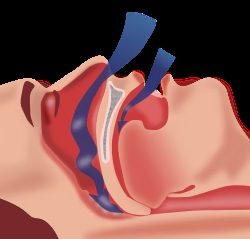
How Does an Apnea Episode Happen?
During obstructive sleep apnea, the upper airway collapses in the region of the pharynx. When you sleep, the throat muscles relax naturally, but in people with apnea this relaxation is excessive, causing the airway to close partially or completely.
Imagine a straw that collapses as you try to breathe through it. Your body keeps working to breathe, creating negative pressure in the chest, but air cannot get through. During each episode, which lasts at least 10 seconds (and may extend beyond a minute), the body enters a state of asphyxia.
What Happens During Each Breathing Pause
When breathing stops, two critical things happen in your body:
Hypoxia: The amount of oxygen in the blood drops sharply. It is as if every cell in your body began to “starve” for oxygen.
Hypercapnia: Carbon dioxide (CO₂) builds up in the blood, creating a toxic environment. It is as if you were breathing stale air.
These events lead special sensors in your body (called chemoreceptors) to detect the danger and send urgent signals to the brain: “You need to breathe now!”. The brain then triggers a micro-arousal. You do not wake up fully, but you come out of deep sleep just enough for the throat muscles to contract and reopen the airway.
The Cascade Effect on the Cardiovascular System
Each apnea episode sets off a storm in your cardiovascular system:
The Sympathetic Nervous System on Maximum Alert
The sympathetic nervous system, responsible for “fight or flight” reactions, is intensely activated. It is a response much like being mugged or attacked by an animal. The difference is that this happens all night long, as if your body believed it were in constant danger. This causes:
- A massive release of adrenaline and other stress hormones
- Vasoconstriction: the blood vessels contract sharply
- Rapid spikes in blood pressure: with each pause, the pressure spikes for a few seconds, which in severe cases may exceed 180 to 200 mmHg. This is not continuous high blood pressure, but this oscillation, repeated hundreds of times a night, overloads the heart and vessels over time

The Heart Under Pressure
With each episode, your heart undergoes tremendous stress:
- A sudden rise in heart rate
- A higher risk of arrhythmias (irregular heartbeats)
- Left ventricular hypertrophy (the heart muscle becomes “swollen” from working so hard)
- An increased risk of heart attack and heart failure
How Sleep Apnea Affects Specific Body Systems
Respiratory System
- Pulmonary hypertension: pressure in the lungs rises due to the lack of oxygen
- Changes in the brain’s respiratory center
- A gradual reduction in lung capacity over time
Endocrine and Metabolic System
Apnea can cause hormonal chaos:
Insulin Resistance: Hypoxia and stress may keep cells from responding properly to insulin, raising the risk of type 2 diabetes. It is as if the cells’ “locks” (insulin receptors) became “rusty”.
Disrupted Appetite Hormones:
- Ghrelin (the hunger hormone): rises sharply
- Leptin (the satiety hormone): decreases
- Elevated Cortisol: The stress hormone stays high, contributing to weight gain and metabolic changes.
Nervous System
Impaired Cognitive Function:
- Memory loss and difficulty concentrating
- Slowed reaction time (similar to the effect of alcohol)
- A higher risk of traffic accidents, about 2 to 3 times higher, especially in severe cases with marked sleepiness (CPAP treatment substantially reduces this risk)
- Mood changes, depression, and anxiety
Stroke Risk: apnea nearly doubles the risk of stroke, independently of factors such as blood pressure, weight, and diabetes (study published in the New England Journal of Medicine, 2005), through the combination of hypertension, changes in cerebral blood flow, and a greater tendency to form clots.
Reproductive System
Apnea can deeply affect the sex hormones and reproductive function in both men and women:
Effects on the Male Reproductive System:
Lower Testosterone: Intermittent hypoxia and sleep fragmentation can inhibit testosterone production by suppressing the hypothalamic-pituitary-gonadal axis. Obstructive apnea is associated with lower testosterone levels, especially in more severe cases and in men with obesity. Much of this relationship, however, is explained by excess weight itself, and treating apnea alone does not always normalize the hormone.
Erectile Dysfunction: The combination of low testosterone, vascular problems, oxidative stress, and altered penile blood flow means that men with apnea may face a significantly higher risk of impotence. Apnea is considered an independent risk factor for erection problems.
Reduced Fertility: Sperm quality may be impaired by hypoxia and oxidative stress, resulting in a lower sperm count, reduced sperm motility, and increased sperm DNA fragmentation. This can make conception more difficult and raise the risk of miscarriage.
Effects on the Female Reproductive System:
Menstrual Irregularities: Apnea may cause irregular menstrual cycles due to hormonal changes, making it harder to identify the fertile window and reducing the chances of conception.
Reduced Fertility: Women with apnea may have difficulty ovulating properly due to an imbalance of the hormones FSH (follicle-stimulating) and LH (luteinizing), both essential for healthy ovulation.
Menopause-Related Problems: Apnea becomes more common after menopause due to the decline in estrogen and progesterone levels, which naturally help maintain the muscle tone of the airway. Hormone deficiency combined with apnea can create a vicious cycle that worsens menopausal symptoms.
Pregnancy Complications: Pregnant women with apnea have a higher risk of gestational hypertension, gestational diabetes, and complications during delivery.
Immune System
Sleep apnea can cause profound dysfunction of the immune system, creating a state of chronic inflammation in the body:
Persistent Inflammatory State: Intermittent hypoxia and sleep fragmentation cause the body to continuously produce pro-inflammatory cytokines such as IL-1, IL-6, and TNF-α. It is as if the body were always “fighting an infection” that does not exist.
Suppressed Immunity: The rise in cortisol and oxidative stress lead to immunosuppression, reducing the body’s ability to fight real infections. This can result in greater susceptibility to colds, flu, pneumonia, and other infectious diseases.
Imbalance of Defense Cells: There is a reduction in CD3+, CD4+, and CD8+ cells (lymphocytes important for defense) and a shift in the balance between cellular (Th1) and humoral (Th2) immune responses, favoring a pattern similar to that seen in autoimmune diseases.
Reduced NK Cell Activity: Natural Killer cells, which help defend the body, may show reduced activity. Laboratory research suggests this could weaken defenses against tumors, but it is important to be clear that this is a hypothesis under investigation: it is not proven that apnea causes cancer in people.
Oxidative Stress: The Assault of Free Radicals
One of the most damaging effects of apnea is the creation of free radicals. With each cycle of oxygen deprivation followed by reoxygenation, it is as if your cells were put through “extreme exercise,” generating toxic substances that damage:
- Blood vessels (accelerating the process of atherosclerosis)
- Heart cells
- Neurons in the brain
- Pancreatic cells (worsening diabetes)
The Vicious Cycle
Apnea creates a vicious cycle that is hard to break:
1. Apnea → Weight gain (due to altered hormones)
2. Weight gain → Worsening apnea (more tissue in the throat)
3. Worse apnea → More metabolic problems
4. More problems → More weight gain
Impact on Overall Health
Cardiovascular: about half of people with apnea also have high blood pressure, and apnea is a recognized cause of hard-to-control hypertension. Long-term studies show that severe apnea nearly triples the risk of developing hypertension. The risk of heart attack, arrhythmias, and heart failure also increases.
Metabolic: The prevalence of type 2 diabetes is much higher in patients with apnea, regardless of weight.
Neurological: A higher risk of dementia, memory loss, and accidents due to drowsiness.
Immunological: Greater susceptibility to infections. The relationship with some types of cancer is a hypothesis still under study, not a certainty.
Reproductive: Reduced fertility, sexual dysfunction, menstrual irregularities, and hormonal disturbances that affect sexual and reproductive quality of life.
Quality of Life: Excessive sleepiness, depression, relationship difficulties, and a significant drop in productivity.
The Good News
The most important point is that treating apnea may reverse many of these problems. When breathing is normalized during sleep (with CPAP, oral appliances, or surgery), the following are often observed:
- A reduction in blood pressure
- Improved diabetes control
- A reduction in oxidative stress
- Improved cognitive function and mood
- Improvement in snoring, daytime sleepiness, and quality of life
Treatment reliably improves symptoms, sleep, mood and quality of life, and helps control blood pressure. Treating is well worth it for symptoms, blood pressure and quality of life.
This shows how an apparently “simple” sleep disorder can have profound consequences for the entire body, but also how appropriate treatment can transform a person’s health and quality of life. See how snoring and sleep apnea surgery works.
Frequently Asked Questions
Does sleep apnea cause cancer?
It is not proven. Laboratory research suggests that intermittent lack of oxygen may weaken part of the body’s defenses (the NK defense cells), but this is still a hypothesis under study, not a proven cause-and-effect relationship in people.
Does treating apnea prevent heart attack and stroke?
Treatment reliably improves snoring, sleepiness, mood, quality of life, and helps control blood pressure. However, the prevention of heart attack and stroke was not demonstrated by the largest randomized trial (SAVE, 2016). Even so, treating is very important for symptoms, blood pressure, and quality of life.
Does apnea raise blood pressure?
Yes. With each pause there is a rapid pressure spike, and over time apnea is a recognized cause of high blood pressure, especially the hard-to-control kind. Severe apnea nearly triples the risk of hypertension.
References
- Peppard PE, Young T, Palta M, Skatrud J. Prospective study of the association between sleep-disordered breathing and hypertension. New England Journal of Medicine. 2000;342:1378-1384.
- Yaggi HK, et al. Obstructive sleep apnea as a risk factor for stroke and death. New England Journal of Medicine. 2005;353:2034-2041.
- Tregear S, et al. Obstructive sleep apnea and risk of motor vehicle crash: systematic review and meta-analysis. Journal of Clinical Sleep Medicine. 2009.
- McEvoy RD, et al. CPAP for Prevention of Cardiovascular Events in Obstructive Sleep Apnea (SAVE trial). New England Journal of Medicine. 2016.
- Su L, et al. Association between obstructive sleep apnea and male serum testosterone: a systematic review and meta-analysis. Andrology. 2022.
Dr. José Eduardo Marcondes, physician, otolaryngologist (ENT). CRM-SP 107.711 (Brazilian medical license) | RQE 43.840 (specialist registration). This content is informational, does not replace a medical consultation, and does not supersede the plan of care defined by your own physician.
Sleep well again.
The diagnosis is individual. Book a consultation and find out what applies to your case.
Read also:
About the author
Dr. José Eduardo Marcondes
Physician, Otolaryngologist (ENT) · CRM-SP 107.711 · RQE 43.840
Trained and completed his residency at Escola Paulista de Medicina (UNIFESP), with more than two decades of experience. Focused on the treatment of snoring and sleep apnea, nasal obstruction, chronic sinusitis, adenoids and tonsils, in adults and children. Member of ABORL-CCF and of the medical staff at Hospital Israelita Albert Einstein, Vila Nova Star and São Luiz.
Learn about his full career → · Book an appointment on WhatsApp
Leave a Reply