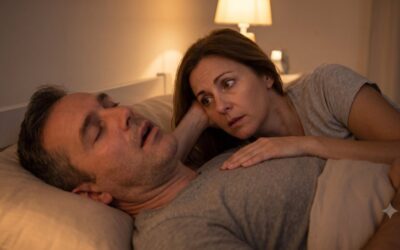
“Doctor, how do I stop snoring?” This is one of the most frequent questions in the office. Or rather, the most frequent question is: “How do I get my husband (or my wife) to stop snoring?” Almost always, the person who booked the appointment is not the one who snores, but the one who sleeps next to them.
The answer begins with a question: why does this person snore? Snoring has several possible origins, and each origin has a treatment of its own. There is a path of investigation and a ladder of treatments, from the simplest to the most advanced. In this article, we explain how to follow that path with clear criteria.
First of all: what is snoring?
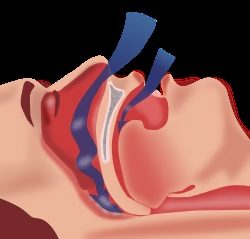
Snoring is the sound of the throat tissues vibrating when air passes through a tight space. It works like a flag in the wind: when air moves freely through a wide space, nothing vibrates; when it has to squeeze through a narrow passage, it speeds up and makes the soft tissues (the soft palate, the uvula, the walls of the throat) vibrate. That vibration is the snore.
Snoring now and then, during a cold or after a dinner with wine, happens to almost everyone. The snoring that deserves attention is loud, frequent snoring that bothers the person sleeping next to you, or snoring that comes with pauses in breathing.
Why do you snore? The answer is in the airflow.
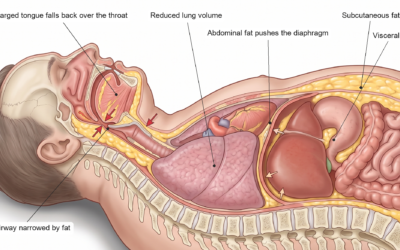
In the office, we usually sum the mechanism up as a simple combination: a narrow upper airway + tissues that relax too much. Each side of that combination has its own causes.
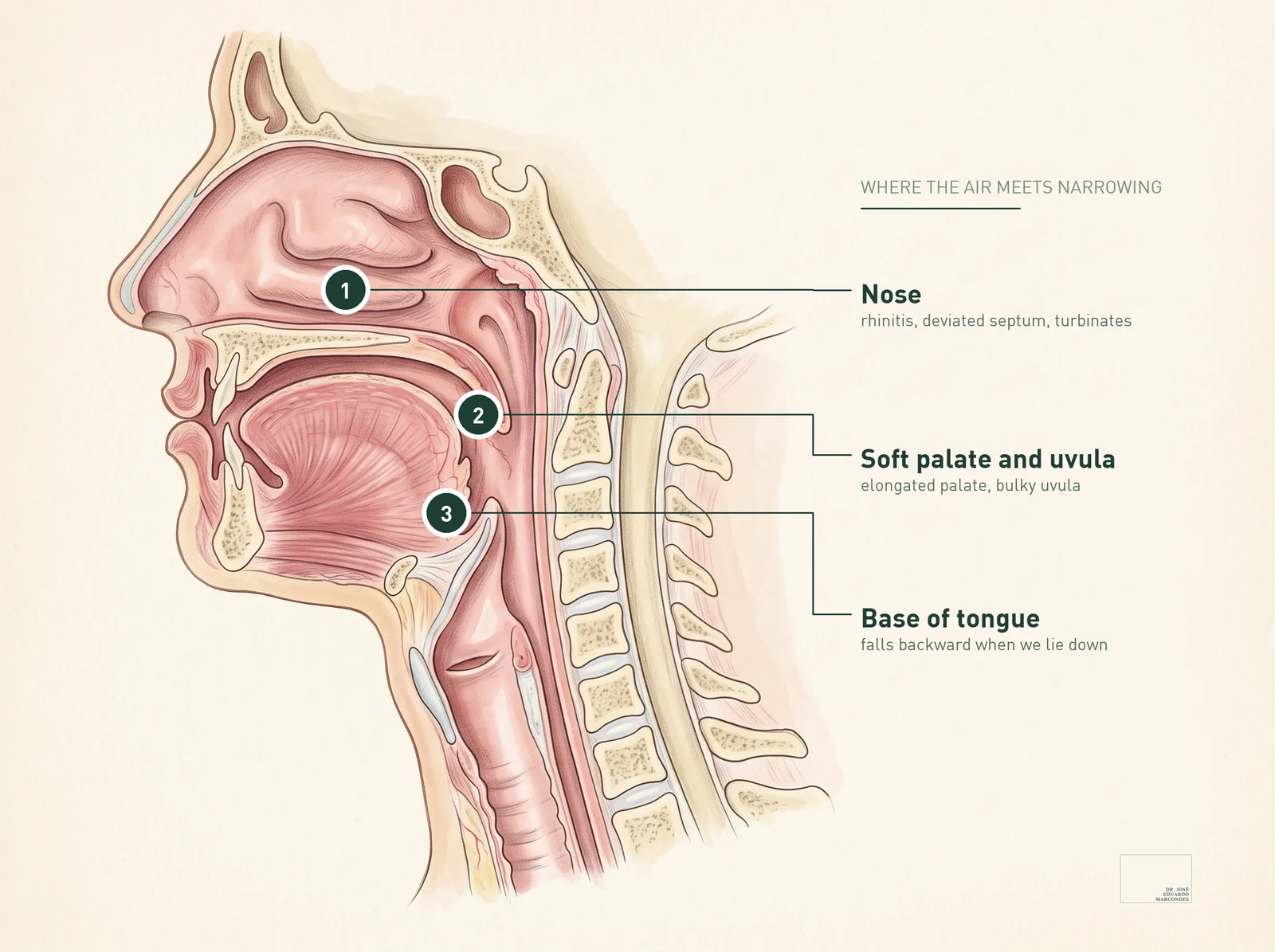
What narrows the upper airway:
- A blocked nose: rhinitis, a deviated nasal septum, enlarged turbinates (the spongy structures inside the nose), nasal polyps
- An elongated soft palate or a bulky uvula
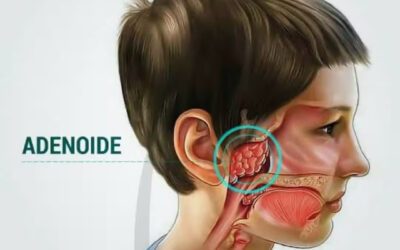
- Enlarged tonsils
- A bulky base of tongue, which falls backward when we lie down
- Excess weight, which deposits tissue around the throat and the neck
What makes the tissues relax too much:
- Sleep itself, especially in the deeper stages
- Alcohol at night, which acts as a muscle relaxant for the throat
- Some sedative medications
- The passing years, which naturally reduce muscle tone
- Menopause, a period in which hormonal changes increase the chance of snoring and sleep apnea in women (Young et al., 2003)
- Sleeping on your back, a position in which the tongue and the palate tend to fall backward
Each person snores because of a different combination of these factors. That is why the right question is not “what is the treatment for snoring?”, but “why does this person snore?”. Investigating before treating is what separates a consistent solution from a shot in the dark.
When snoring stops being just snoring: sleep apnea
Not all snoring is a disease. There is what we call primary snoring, in which the person snores but breathes well all night long. And there is snoring that is a symptom of obstructive sleep apnea (OSA), a condition in which the throat closes completely, over and over again, causing pauses in breathing (apneas), drops in oxygen, and arousals that fragment sleep.
Is this common? More than people imagine. The EPISONO study, which assessed the adult population of the city of São Paulo with sleep studies, found obstructive sleep apnea syndrome in 32.8% of the adults evaluated (Tufik et al., 2010). Most of them did not know they had it.
The signs that raise the suspicion of sleep apnea, in addition to loud snoring:
- Pauses in breathing witnessed by the person who sleeps next to you
- Waking up choking or with a feeling of suffocation
- Sleep that does not restore: waking up tired even after enough hours in bed
- Sleepiness during the day, at work or at the wheel
- Morning headache, dry mouth on waking
- High blood pressure that is hard to control
The STOP-Bang questionnaire: how these questions can help you
One tool we use to organize that suspicion is the STOP-Bang questionnaire, published by Chung et al. in 2008. It brings together 8 simple questions and works as a screening instrument, not a diagnostic one. It gives clues about who should be investigated.
The 8 questions, in plain language:
- Do you snore loudly (louder than talking, loud enough to be heard from another room)?
- Do you often feel tired or sleepy during the day?
- Has anyone ever observed you stop breathing while you sleep?
- Do you have high blood pressure, or are you being treated for hypertension?
- Is your body mass index (BMI) above 35?
- Are you over 50 years old?
- Is your neck circumference greater than 40 cm?
- Are you male?
In the original study, three or more positive answers indicate an increased risk of OSA (Chung et al., 2008). The questionnaire points to who should be investigated; the diagnosis comes from the consultation and from a sleep study (polysomnography), which measures how many times breathing is interrupted per hour and how far blood oxygen falls. We explain this path in detail on the page about sleep apnea.
Did you answer yes to three or more of them? Bring your answers to the appointment: they help direct the investigation from day one. Book a Consultation and let us find out where your snoring comes from.
The treatment ladder: what works at each step
Snoring has a treatment, and the right treatment depends on where the narrowing is. That is why the ladder below runs from the simplest to the most advanced, and why the examination comes before the choice.
1. Behavioral measures
Losing weight when there is excess weight, avoiding alcohol at night, taking care of the sleep routine, and training yourself to sleep on your side. This is the base of the ladder and it is part of every patient’s plan: on its own in mild snoring with no anatomical obstruction, and added to the other steps when there is a point of narrowing to treat or when the sleep apnea is moderate or severe.
2. Treating the nose
Poorly controlled rhinitis, a deviated nasal septum, and enlarged turbinates narrow the air intake right at the door. Treating the nose, with medication or surgery depending on the case, reduces the effort it takes to breathe with the mouth closed and improves tolerance to the other treatments. It is part of the plan for every person who snores and has nasal obstruction, and it can be combined with other surgeries within the same surgical plan.
3. CPAP
The continuous positive airway pressure device (CPAP) keeps the airway open with a gentle flow of air during sleep. It is the standard treatment for moderate and severe sleep apnea: the American Academy of Sleep Medicine guideline recommends positive airway pressure for the treatment of OSA in adults, with a strong recommendation when excessive sleepiness is present (Patil et al., 2019). It acts on the nights when it is used, and that is why adaptation weighs as much as the indication. A blocked nose is one of the most frequent reasons for giving up on it, and that is where the otolaryngologist (ENT) comes in even when the treatment is medical rather than surgical.
4. Oral appliance
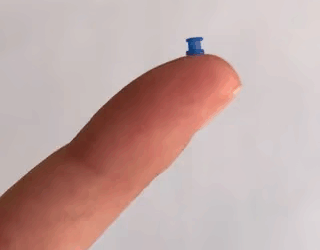
The oral appliance (mandibular advancement device, or MAD) moves the lower jaw slightly forward during sleep, opening up space behind the tongue. It is a good choice in primary snoring and in mild to moderate sleep apnea, with follow-up by a dentist qualified in dental sleep medicine, and it depends on the teeth and the joint being in condition to support the device, which is assessed before it is indicated.
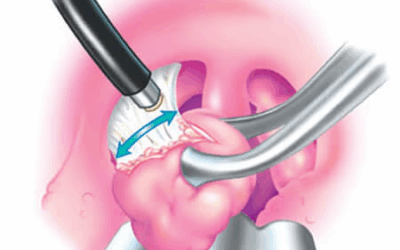
5. Barbed reposition pharyngoplasty (BRP)
A palate repositioning surgery: it repositions and tightens the tissues of the palate and the pharyngeal walls using threads with micro-anchors, without removing large volumes of tissue. It treats retropalatal collapse, that is, the collapse that happens behind the palate. The indication combines clinical history, ENT examination, and polysomnography; drug-induced sleep endoscopy (DISE) can be useful in some cases. Details of the procedure on the page about barbed reposition pharyngoplasty.
6. Fotona laser (NightLase protocol)
A non-surgical protocol in which laser energy promotes contraction and firmness of the palatal tissues, without incisions and without general anesthesia. It is an alternative for people with primary snoring who want an option without surgery. In the protocol we use in our office, treatment is delivered as an initial course of sessions, generally 4, followed by 1 maintenance session every 6 to 12 months. We explain the indications on the page about the Fotona laser.
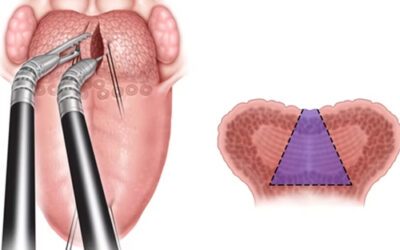
7. Transoral robotic surgery (TORS)
Surgery performed with the robot, which makes it possible to reach and treat with precision deep regions of the throat that conventional instruments reach only with difficulty.
Robotics is the route of access, not a single technique. Through it, we treat three territories of the upper airway: the base of tongue, the lateral pharyngeal wall, and the palate. It is through the robotic approach, for example, that we perform expansion sphincter pharyngoplasty (ESP), the lateral wall technique we use most often. It is done in a hospital setting, with postoperative follow-up, and it can be combined with barbed reposition pharyngoplasty and with septal surgery within the same surgical plan. Learn more on the page about TORS.
How we choose the right step
No step of the ladder fits everyone, and that is what the consultation resolves. Three things define the choice, and all three come before any decision:
Where the narrowing is. The nose, the palate, the lateral pharyngeal wall, or the base of tongue. Examining the nose and the throat identifies the point, and it is the point that separates the person who improves by treating the nose from the person who needs the throat treated. Treating the nose alone usually improves breathing and adherence to CPAP, and the snoring itself arises more often in the throat.
The severity. Primary snoring and mild sleep apnea open room for the oral appliance and for the laser; in moderate and severe sleep apnea the standard treatment is CPAP, and the laser does not take that place. In the heavier cases, behavioral measures come added to another step, not on their own.
Your own conditions and your own preferences. Surgery involves a postoperative recovery and patient selection; the oral appliance requires dental conditions; CPAP requires living with the device. We take that into account together with you, because a treatment that does not hold up in your routine does not treat.
Be wary of anyone who promises a single solution for snoring before examining you. The ladder exists precisely because the right answer changes from person to person.
The bridge between the nose and sleep
Here is a point that often goes unnoticed: the nose and sleep are a single system. Nasal obstruction worsens snoring, aggravates sleep apnea, and gets in the way of adherence to CPAP, because breathing under pressure with a blocked nose is like drawing air through a crushed straw.
In everyday practice, this means that treating rhinitis, correcting a deviated nasal septum, or reducing the turbinates acts on sleep along two routes: it reduces the nasal share of the snoring, and it allows CPAP or the oral appliance to work the way they should. We often see patients who “did not adapt to CPAP” and find that the problem was never the device. It was the nose.
Frequently asked questions
What causes snoring?
The combination of a narrow upper airway (from a blocked nose, an elongated palate, large tonsils, a bulky base of tongue, or excess weight) with the natural relaxation of the muscles during sleep. Alcohol, sedatives, age, and sleeping on your back accentuate that relaxation.
Is snoring normal?
Snoring occasionally, during a cold or after drinking alcohol, is common. Loud, frequent snoring, especially with pauses in breathing or daytime sleepiness, should not be treated as normal: it deserves investigation.
When is snoring a concern?
When it comes with pauses in breathing witnessed by another person, nighttime choking, sleep that does not restore, daytime sleepiness, or high blood pressure. Three or more positive answers on the STOP-Bang questionnaire also indicate an increased risk of sleep apnea and justify an evaluation (Chung et al., 2008).
Can snoring be cured?
It depends on the cause. When there is a clear, treatable anatomical factor, snoring can disappear or be substantially reduced. In other cases, the goal is control, as happens with high blood pressure: the treatment is ongoing, not one-off. The serious answer begins with investigating the cause.
Does snoring surgery work?
It works when the indication is right. Current techniques (barbed reposition pharyngoplasty, TORS, nasal surgery) treat the exact site of collapse, identified through examination. It is the investigation that separates the surgery that solves the problem from the surgery that disappoints, and that is why it comes first.
Does sleeping on your side solve snoring?
It helps in some cases, because on your side the tongue and the palate fall backward less. For someone who snores in any position, or who has sleep apnea, position on its own is not enough and the cause needs to be investigated.
References
- Chung F, Yegneswaran B, Liao P, et al. STOP Questionnaire: a tool to screen patients for obstructive sleep apnea. Anesthesiology. 2008;108(5):812-821.
- Tufik S, Santos-Silva R, Taddei JA, Bittencourt LRA. Obstructive sleep apnea syndrome in the Sao Paulo Epidemiologic Sleep Study (EPISONO). Sleep Medicine. 2010;11(5):441-446.
- Patil SP, Ayappa IA, Caples SM, et al. Treatment of adult obstructive sleep apnea with positive airway pressure: an American Academy of Sleep Medicine clinical practice guideline. Journal of Clinical Sleep Medicine. 2019;15(2):335-343.
- Young T, Finn L, Austin D, Peterson A. Menopausal status and sleep-disordered breathing in the Wisconsin Sleep Cohort Study. American Journal of Respiratory and Critical Care Medicine. 2003;167(9):1181-1185.
If snoring is part of your nights, or of the nights of whoever sleeps next to you, the first step is to find out where it comes from. Book a Consultation at the Morumbi, Itaim Bibi, or Alphaville locations, and we will examine your nose and your throat to find the right step for your case.
Dr. José Eduardo Marcondes, otolaryngologist (ENT physician). CRM-SP 107.711 (Brazilian medical license) | RQE 43.840 (specialist registration). This content does not replace a medical consultation.
Read also:
About the author
Dr. José Eduardo Marcondes
Otolaryngologist (ENT) · CRM-SP 107.711 · RQE 43.840
Trained and completed his residency at Escola Paulista de Medicina (UNIFESP), with more than two decades of experience. A pioneer in the use of robotic surgery (TORS) for sleep apnea. Member of the clinical staff at Hospital Albert Einstein, Vila Nova Star and São Luiz. Member of ABORL-CCF.
Learn about his full career → · Schedule an appointment on WhatsApp